A step-through frame, a low diamond and a 650b small-frame build, ridden back to back to see which one fits a rider under five foot four
Three kinds of hybrid, one set of roads. Which cluster actually fits yours?
Head angle degrees to expect
Flat-bar road hybrids typically sit around 71 to 73 degrees at the head tube, while comfort and trekking frames run nearer 68 or 69. That difference is felt most at low speed and in traffic.Small-size geometry drift
Many brands steepen the head angle on their smallest frames to avoid toe overlap, which makes the bike twitchier for the rider least likely to want that. Always read the chart row for the size you would actually buy.The 650b workaround
Some manufacturers fit smaller diameter wheels on their shortest frames instead of altering the angles. This keeps handling consistent across the size run and is a good sign the small sizes were designed rather than shrunk.In short
- Full-coverage fenders want roughly ten millimeters of clearance beyond the tire itself. A frame rated for the tire you want with nothing to spare will rub in the first wet month.
- The number of speeds on the sticker tells you very little. What matters is the ratio at each end, particularly whether the lowest gear gets below one-to-one for loaded hills.
- Swapping tires is usually the cheapest meaningful change to how a hybrid rides, running to a pair plus tubes rather than a shop visit. It only works if the frame allows the width you want.
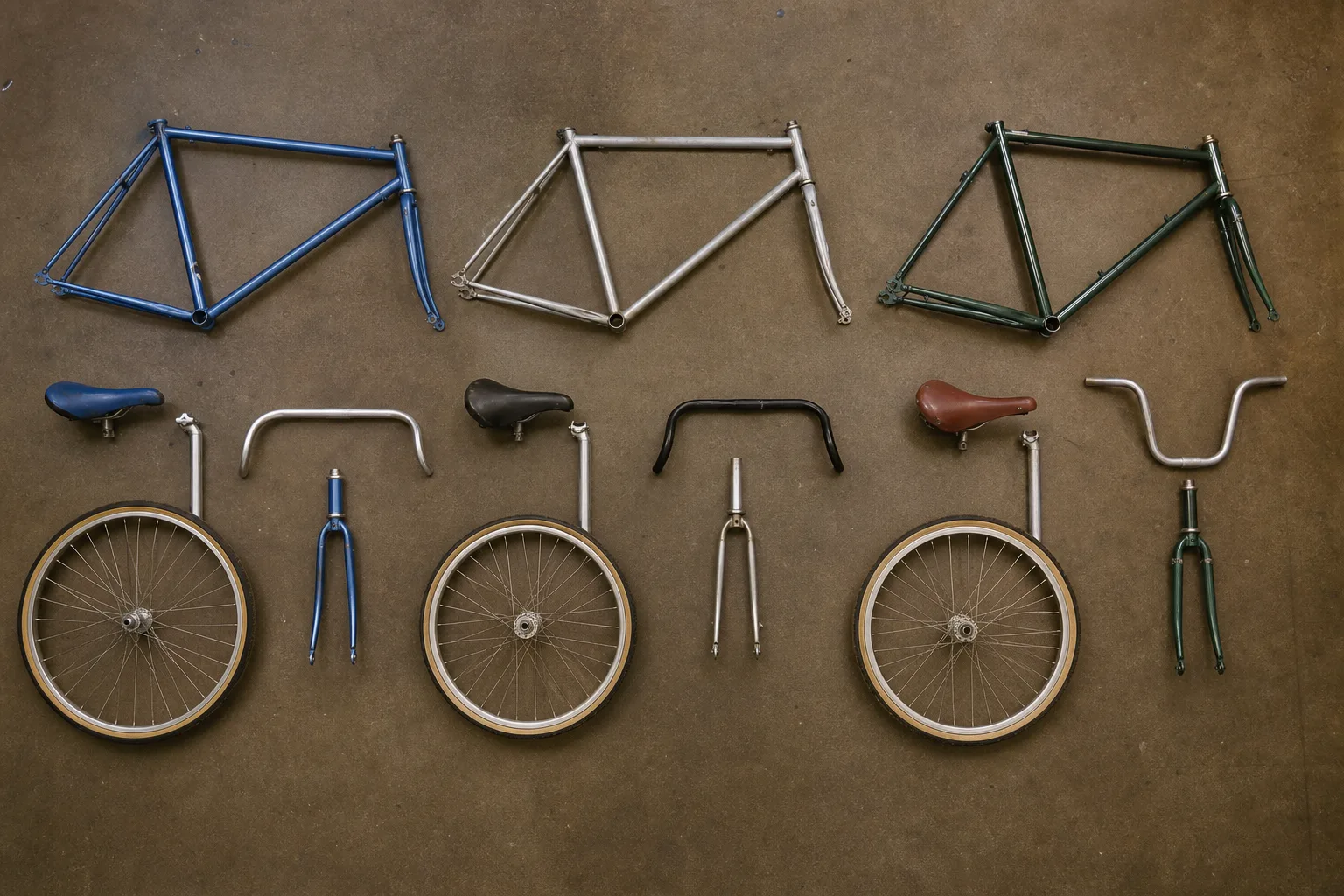
The word hybrid covers bikes that share almost nothing beyond flat handlebars and a wheel at each end. A shop floor will show you a lightweight machine on 32mm tires with drop-bar geometry underneath it, an upright cruiser with swept bars and a wide saddle, and a steel-forked trekking bike with rack mounts and knobby rubber, all under the same sign and often within a few hundred dollars of each other. Those are three different vehicles. Buying across the gap by accident is the most common expensive mistake in this category, because the fix is usually a second bike rather than a second stem.
The three clusters, and what separates them
Flat-bar road bikes are road frames with a straight handlebar bolted on. They run tire clearance in the high twenties to mid thirties in millimeters, a head angle around 71 to 73 degrees, and gearing that tops out high and bottoms out around a one-to-one ratio at best. Comfort and upright bikes sit at the other end: relaxed head angles near 68 or 69 degrees, tall head tubes, tires from 38 to 45mm, and gearing shifted low across the whole range. Rugged trekking bikes take the upright frame's stability and add clearance to 50mm or more, plus mounts for everything.
Those three numbers, clearance, head angle and gear range, are not styling choices. They are the manufacturer telling you what surface the bike was designed to spend its life on, and they constrain each other. You cannot fit 47mm tires into a frame built around 32mm ones, and you cannot make a bike with a 73 degree head angle feel unhurried at 8 miles an hour by changing the stem. Read the specification sheet for those three figures and most of the marketing copy above them becomes redundant.
What tire clearance is really telling you
Clearance is the single most honest spec on a hybrid, because it is physically fixed and cannot be walked back. A frame with room for 45mm tires can be run at 32mm if you want speed later; a frame with room for 32mm can never be run at 45mm, no matter what you spend. That asymmetry matters more than it sounds, because tire width is the cheapest ride-quality change available, usually forty to eighty dollars for a pair plus tubes, against a frame swap that means selling the bike. If your roads have frost heave, gravel shoulders, or the kind of patched asphalt that appears after a utility dig, buy the clearance you might want in three years.
Clearance also predicts fender and rack compatibility, which is where everyday riding lives or dies. A frame with 45mm of tire room usually has 55mm of actual room, which means full fenders fit without rubbing, and full fenders are the difference between a bike you ride in November and one you do not. The Consumer Product Safety Commission oversees bicycle equipment standards in the United States, and the reflector and brake requirements that come with a new bike assume it will be ridden on roads, not stored.
Head angle, and why smaller riders feel it more
A steep head angle gives quick steering and a shorter wheelbase; a slack one gives stability and more room between your foot and the front wheel. On a small frame the effect is amplified, because designers often steepen the head angle on the smallest sizes to keep the toe from hitting the tire, and the result is a bike that feels nervous at low speed exactly where a shorter rider is most likely to be riding. If you are under about five foot four, check the geometry chart for the size you would actually buy rather than the size the review tested. Manufacturers who take small sizes seriously often use 650b or 26 inch wheels below a certain frame size, which solves the toe overlap without steepening anything.
This is why the upright and trekking clusters tend to suit smaller riders better in practice, and why collections filed under Womens Hybrid Bikes skew heavily toward slack head angles, low standover and swept bars. The trade-off is real: those bikes are slower, and a longer commute on one is genuinely more work. Decide which of those two costs you would rather pay before you look at a single price tag.
What the wrong cluster costs
Buying a flat-bar road bike for a route with dirt sections costs you tires you cannot fit, fenders that rub, and a bike you stop riding by the second winter. Buying an upright comfort bike for a twelve mile each-way commute costs you fifteen minutes a day and a gear range that runs out on the flat, which no component swap recovers. Buying trekking when you ride four flat paved miles costs you about six extra pounds and some rolling resistance, which is the mildest of the three errors and the reason trekking is the safe default when you genuinely do not know. Map your actual week first: surface, distance, hills, whether you carry anything. Then shop.
The specification sheet answers the question before the test ride does, and it answers it the same way in every store. Clearance, head angle, gear range. Three numbers, and the category sorts itself.
A rugged trekking hybrid typically carries several extra pounds over a flat-bar road model, mostly in the fork, wheels and mounting hardware. On flat, short rides that penalty is small enough to ignore.